The Museum of Art of Sao Paulo Construction Type
| Museu de Arte de São Paulo Assis Chateaubriand | |
 | |
 | |
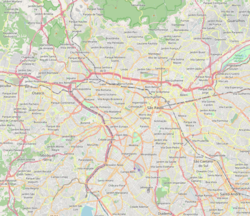
| Location of São Paulo Museum of Art in São Paulo Show map of São Paulo São Paulo Museum of Art (Brazil) Show map of Brazil | |
| Established | 1947 |
|---|---|
| Location | Avenida Paulista 1578, São Paulo, Brazil |
| Coordinates | 23°33′forty″S 46°39′21″Due west / 23.5611°S 46.6558°W / -23.5611; -46.6558 Coordinates: 23°33′twoscore″S 46°39′21″Westward / 23.5611°South 46.6558°W / -23.5611; -46.6558 |
| Visitors | 314,859 (in 2015)[1] |
| Manager | Heitor Martins |
| Curator | Adriano Pedrosa |
| Public transit access |   Trianon-Masp Trianon-Masp |
| Website | www |

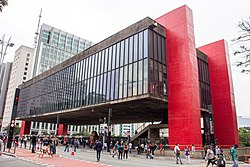
The São Paulo Museum of Art (Portuguese: Museu de Arte de São Paulo, or MASP ) is an art museum located on Paulista Avenue in the metropolis of São Paulo, Brazil.[2] [iii] It is well known for its headquarters, a 1968 concrete and glass structure designed by Lina Bo Bardi, whose main body is supported by two lateral beams over a 74 metres (243 ft) freestanding space, considered a landmark of the city and a principal symbol of modern Brazilian architecture.[iv]
The museum is a not-profit establishment founded in 1947 by Assis Chateaubriand and Pietro Maria Bardi. MASP distinguished itself for many of import initiatives concerning museology and art teaching in Brazil, as well equally for its pioneering office as a cultural middle.[five] It was also the commencement Brazilian museum interested in post-World War II art.
The museum is internationally recognized for its collection of European fine art, considered the finest in Latin America and all Southern Hemisphere.[iv] [6] It besides houses an emphatic aggregation of Brazilian art, prints and drawings, also as smaller collections of African and Asian fine art, antiquities, decorative arts, and others, amounting to more than than eight,000 pieces. MASP also has i of the largest art libraries in the state. The entire collection was placed to the Brazilian National Heritage list by Brazil'south Institute of History and Art.[seven]
History [edit]
General context [edit]


At the cease of the 1940s, the Brazilian economic system was going through big structural changes as a outcome of accelerating industrialization. The city of São Paulo after established itself as the virtually important industrial hub in the country. At the that time, São Paulo's most important fine art reference was the Week of Modern Art of 1922. Despite the importance this upshot had enjoyed in the 1920s, Modernism wouldn't draw much attention of city dwellers and institutions in the following decades. In that location was only ane art museum in São Paulo, the Pinacoteca practice Estado, solely devoted to Academic fine art, and a commercial gallery.
Assis Chateaubriand, founder and owner of Diários Associados, or "Associated Daily Printing", the largest media and press conglomerate of Brazil at the time, was one of the most influential individuals of this period. Chateaubriand would started a campaign to acquire masterpieces to form an art collection of international renown in Brazil.[viii] He intended to host the museum in Rio de Janeiro, merely ultimately chose São Paulo where he believed it would be easier to gather the necessary funds, since this urban center was enjoying a very prosperous moment. At the aforementioned time, the European art market place had been deeply influenced by the terminate of World State of war Ii, making it possible to acquire fine artworks for reasonable prices.
With the help of Pietro Maria Bardi, an Italian professor, critic, art dealer and erstwhile owner of galleries in Milan and Rome, Chateaubriand created a "Museum of Classical and Mod Art".[9] Planning to pb the project for merely a year, Bardi defended the residuum of his life to information technology. He moved to Brazil together with his wife, the architect Lina Bo Bardi, and brought forth his library and his private fine art collection.
Ancestry (1947–1957) [edit]


François Clouet (French, 1510–1572). The Bath of Diana, 1559/threescore. Oil on wood, 78 ten 110 cm.
The museum was inaugurated and opened to the public on 2 Oct 1947, displaying the offset acquisitions, amidst which canvases by Picasso and Rembrandt. In these start years of action, the museum was located on the first floor of the Diarios Associados headquarters. Lina Bo Bardi was in accuse of adapting the edifice to the needs of the museum, dividing it into four distinct areas: an art gallery, a didactic exposition room most the history of art, a temporary exhibition room and an auditorium.
MASP was the first Brazilian establishment interested in acquiring works of mod art. The museum speedily became a coming together betoken for artists, students and intellectuals, attracted non just by its holdings, but also because of the workshops and fine art courses it offered.
In the 1950s, the museum created the Establish of Gimmicky Art (offering workshops of engraving, drawing, painting, sculpture, trip the light fantastic toe and industrial design), the Publicity School (presently Superior Schoolhouse of Propaganda and Marketing), organizing debates about cinema and literature and creating a youth orchestra and a ballet visitor. The courses were oftentimes given by important names of the Brazilian artistic scene, such every bit the painters Lasar Segall and Roberto Sambonet, the architects Gian Carlo Palanti and Lina Bo Bardi, the sculptor Baronial Zamoyski, and the motion-movie technician Alberto Cavalcanti.
Forth with the amplification of the educational plan, the museum expanded its collection and began to be recognized internationally. Betwixt 1953 and 1957, a choice of 100 masterpieces housed in the museum traveled throughout European museums, such equally Musée de l'Orangerie (Paris) and the Tate Gallery (London), in a series of exhibitions organized with the intent of consolidating the collection. In 1957, the collection was also displayed in the United States at the Metropolitan Museum of Art in New York Metropolis and in the Toledo Museum of Art. The following yr, the holdings of MASP were exhibited at other Brazilian venues, such every bit the Museu Nacional de Belas Artes, in Rio de Janeiro. This established the museum on a global level.
Consolidation of the museum [edit]

The collection's ascension growth and importance shortly required the construction of a edifice to headquarter the museum. With that purpose, the São Paulo Urban center Hall donated a plot of ground, previously occupied by the Belvedere Trianon – a traditional meeting point of the Paulistano wealthy, which had been demolished in 1951 – to host the first edition of São Paulo Fine art Biennial. The ground on Paulista Avenue had been donated to the City Hall with the condition that the view to the downtown area and the valley of the Nove de Julho Avenue be preserved.
The new MASP building is the brainchild of Lina Bo Bardi. To preserve the required view of the downtown expanse, Bardi idealized a sustained building, supported past four massive concrete plain rectangular columns. The construction is considered to be unique worldwide for its peculiarity: the principal trunk of the building stands on four lateral supporting pillars, generating a free area of 74 meters underneath the sustained building. Constructed between 1956 and 1968, the new site of the museum was inaugurated on vii November past Queen Elizabeth II of the United Kingdom during her visit to Brazil.
Assis Chateaubriand would non go to meet the inauguration of the new edifice. He died months before, victime of thrombosis. The media empire which he raised had also been facing difficulties since the kickoff of the 1960s. Growing debts and the competition in the media market by Roberto Marinho'south press conglomerate – caused the scarcity of the funds which had permitted the gathering of the collection.
The overthrow of Diários Associados and the death of its founder fabricated the government intervene and pay for some of the debts contracted with strange institutions. During the authorities of president Juscelino Kubitschek, Caixa Econômica Federal granted a loan to award the fiscal obligations of the institution and secured the loan with its art collections. Years afterward, in the 1970s, the debt with the Brazilian regime was negotiated and paid off.
In 1969, in response to a request by the museum, the Brazilian Found for Celebrated and Artistic Heritage (IPHAN) registered MASP's holdings equally part of the national heritage.
In the 1970s the museum gathered notoriety in the Eastern Hemisphere by organizing many exhibitions using selected works of its collection at Japanese museums. In 1973, the drove was presented at the Ministry of Strange Relations in Brasília. MASP's collection was presented over again in Japan in 1978/79, 1982/83, 1990/91, and 1995. In 1992, works of the French school and Brazilian landscapes were exhibited in the Museo Nacional de Bellas Artes, in Santiago, Chile, and in the Biblioteca Luís Angel Aragón, in Bogotá.
In 2011, MASP received an important donation of Asian Fine art and artcrafts from Administrator Godoy to India, which is said to accept placed MASP nether the same category of the Metropolitan Museum of Fine art of New York, which houses items of anthropological interest as well as fine arts.[ citation needed ] Before that, MASP already figured amongst the xix finest institutions of fine art in the world, which include D'Orsay in Paris and the Met itself.[ commendation needed ] A new fly to harbor the collection volition be dedicated in 2012, when MASP'south eating house and offices will be transferred to a building under restoration to its left.
The building [edit]


Exhibition room, São Paulo Museum of Art.

Exhibition of the "100 Maravilhas".
The nowadays building of the museum was constructed by the São Paulo City Hall and inaugurated in 1968, in the presence of Queen Elizabeth II of the United kingdom. Information technology is famous for its remarkable brutalist construction and it is considered one of the landmarks of the Brazilian modernistic compages. The edifice should be raised in the formerly site of Belvedere Trianon, on Paulista Artery from where it would be possible to sentry the downtown area and the Cantareira Mountains. José Borges de Figueiredo, the investor who sold the plot of ground to the Urban center Hall, wrote a non-bounden letter to the administration, asking that it exist preserved as a "public place in perpetuity". While in the following years multiple proposed projects ignored his wish, the thought of an underground construction or, otherwise, a sustained i was called past the builder Lina Bo Bardi and engineer José Carlos Figueiredo Ferraz nevertheless. They conceived an underground block every bit well as a sustained structure, which would stand eight meters higher up the floor, with the use of four pillars connected by two huge concrete beams. Underneath those beams there lay what was considered a disrespect, pregnant a free space of 74 metres (243 ft) between the pillars and underneath the beams; the largest in the world at that time.[10] The building inaugurated the so-chosen protented technique reinforced concrete in Brazil.
In the construction of approximately ten,000 square metres (110,000 sq ft) there are – besides the permanent and temporary exhibition rooms – library, photograph gallery, pic gallery, video gallery, two auditoriums, restaurant, a store, workshop rooms, administrative offices and a technical reserved area. The building'south installations and finishing are homely, as Lina Bo herself describes: "Concrete in sight, whitewash, flagstone floor covering the great Civic Hall, tempered glass, plastic walls. Industrial black rubber flooring covering inner spaces. The belvedere is a 'square', with plants and flowers around, paved with parallelepipeds, according to Iberian-Brazilian tradition. At that place are also water spaces, small water mirrors with aquatic plants.[11] […] I didn't search for dazzler. I've searched for freedom".[12] In 2003, the edifice was also registered equally national patrimony by Brazilian Institute for Celebrated and Artistic Heritage.
In the museographic area, Lina Bo Bardi too innovated past using tempered crystal sheets leaned on concrete blocks bases as display supports for the paintings. The intention is to imitate the position of the sheet on the painter's easel. In the reverse of these supports, which are non used anymore, at that place were planks with information about the painter and the work. Paradoxically, the museum abandoned this model of exhibition at the same fourth dimension when, at the end of the 1990s, it starts to exist noticed and implemented by foreign institutions.
Between 1996 and 2001, the current administration of the museum undertook a vast and controversial reform. Notwithstanding the indispensable restoration of the general structure, the architect and quondam director of the establishment Julio Neves adamant the substitution of the original floor conceived by Lina Bo, the installation of a second lift, the construction of a third underground floor, and the substitution of the water mirrors for gardens. Many architects allege that the reform caused a profound discharacterization of Lina'south original project.[thirteen]
The collection [edit]
The formation of the collection [edit]

Peter Paul Rubens and Workshop (Flemish, 1577–1640). Portrait of Albert VII, Archduke of Austria, c. 1615/32. Oil on canvas, 200 10 118 cm.
The main torso of the collection was gathered between 1947 and 1960. Pietro Maria Bardi, formerly owner of commercial galleries in Milan and Rome, was in charge of searching and selecting the works which should exist acquired, while Chateaubriand had to look for donors and patrons who shared his dream of endowing the country with a museum of international standard. Although many spontaneous donations had been registered, Chateaubriand gained reputation for using bold methods of persuasion. Endorsed by the influence of his Diários Associados Press, he negotiated with announcers his gathering of funds. Subsequently that, he rewarded the donors with the title of patrons, celebrating each new acquisition with banquets, speeches and even student parades in the streets of São Paulo, equally happened at the arrival of Van Gogh's The Student.
The international art market was passing through a propitious moment for those who had funds to larn high-quality works of art – there were many of them bachelor in view of the stop of the war, and Brazil enjoyed prosperity, having ceased to depend heavily on international product, as it was forced to develop its ain industry during the war. The works of art were generally acquired in traditional and esteemed fine art auction houses, such as Christie's, Marlborough, Sotheby'due south, Knoedler, Seligman and Wildenstein.
The bold methods used by Chateaubriand to finance the formation of the drove produced many critics. Forth with these, there were others related to the fact that the museum acquired works of art without the proper corroboration of authenticity. This impression was endorsed by the fact that the museum was at the time one of the major buyers in the international market. Unlike other institutions, whose acquisitions depended on approval of a curators council, the São Paulo Museum of Art usually acquired its pieces quickly, sometimes past telegram. Thanks to this agility the museum was able to get together important masterpieces, even when facing private collectors or institutions of major renown and bigger financial resources.
At the stop of the 1960s, Chateaubriand's press conglomerate was facing troubles, with growing debts and Roberto Marinho's media companies competition. The financial difficulties of Diários Associados acquired the downfall of the museum'south financial resources. Thus, afterwards thirteen years of great acquisitions, the museum increased its drove only by spontaneous donations of artists, companies and private collectors.
Overview of the collection [edit]
The São Paulo Museum of Art collection is considered the largest and more comprehensive collection of Western art in Latin America and all Southern Hemisphere. Among the eight,000 works of the museum, the collection of European paintings, sculptures, drawings, engravings, and decorative arts stands out. The French and Italian schools are more than broadly represented, forming the principal body of the drove, followed by Spanish, Portuguese, Flemish, Dutch, English and German masters. The museum also keeps a significant drove of Brazilian art and Brasiliana, which witnesses the development of Brazilian art from 17th century to nowadays. Still in the context of Western art, the museum possesses important holdings of Latin and Due north American art. In a smaller scale, the museum's holdings contemplate representative objects of many periods and distinct not-Western civilizations – such as African and Asian arts – and others which stand out for their technological, archaeological, historic, and artistic relevance, like the select collections of Egyptian, Etruscan, Greek and Roman antiquities, besides other artifacts of Pre-Columbian cultures and medieval European art.
Paintings [edit]
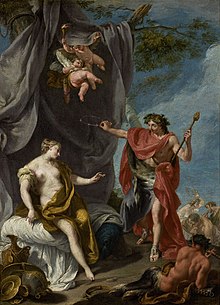

Italian schoolhouse

-
- Tiziano Vecelli (known as Titian) – ane painting
- Tintoretto, Jacopo Comin – ii paintings
- Giambattista Pittoni – i painting, Dioniso e Ariadne
- Sanzio, Raffaello – 1 Painting, Resurrection of Christ
- Botticelli, Sandro – 1 painting, Virgin and Child with the Baby St. John the Baptist
- Mantegna, Andrea – 1 painting
- Perugino, Pietro −1 painting
- Allori, Alessandro – 1 painting
- d'Antonio, Biagio – ane painting
- Bassano, Jacopo (Jacopo dal Ponte) – 1 painting
- Bellini, Giovanni – i painting, Madonna Willys
- Bordone, Paris – one painting
- Guercino – i painting
- di Cosimo, Piero – 1 painting
- Francia, Francesco (Francesco Raibolini) – 1 painting
- Giampietrino (Gian Pietro Rizzi) – ane painting
- Nelli, Ottaviano – ane painting
- Reni, Guido – 1 painting
- Saraceni, Carlo – ane painting
- del Sellaio, Jacopo – 1 painting
Brazil and the Americas
-
- de Almeida Júnior, José Ferraz – vi paintings
- practice Amaral, Tarsila – 2 paintings
- Américo de Figueiredo e Mello, Pedro – 2 paintings
- Calixto de Jesus, Benedito – 3 paintings
- Di Cavalcanti, Emiliano – 2 paintings
- Malfatti, Anita – 2 paintings
- Meirelles de Lima, Victor – 4 paintings
- Portinari, Candido – 17 paintings
- do Rêgo Monteiro, Vicente – 2 paintings
- Rivera, Diego – 2 paintings
- Segall, Lasar – two paintings
- Stuart, Gilbert – one painting
- Volpi, Alfredo – ane painting
- Visconti, Eliseu – two paintings
French school


-
- Bonnard, Pierre – one painting
- Cézanne, Paul – 5 paintings
- Chardin, Jean-Baptiste-Siméon – 1 painting
- Clouet, François – 1 painting
- Corot, Jean-Baptiste-Camille – 5 paintings
- Courbet, Gustave – 2 paintings
- Debret, Jean-Baptiste – 1 painting
- Degas (Hilaire-Germain-Edgar De Gas) – iii paintings
- Delacroix, Eugène – 4 paintings
- Drouais, François-Hubert – 1 painting
- Fragonard, Jean-Honoré – 2 paintings
- Gauguin, Paul – 2 paintings
- Gobert, Pierre – 1 painting
- Ingres, Jean-Auguste-Dominique – 3 paintings
- Lemoyne, François – 1 painting
- Léger, Fernand – 1 painting
- Manet, Édouard – 4 paintings
- Matisse, Henry – 2 paintings
- Mignard, Pierre (and workshop) – 1 painting
- Modigliani, Amedeo – five paintings
- Monet, Claude – ii paintings, including Boating on the River Epte
- Nattier, Jean-Marc – 4 paintings
- Pater, Jean-Baptiste – one painting
- Picasso, Pablo Ruiz – 3 paintings, including Portrait of Suzanne Bloch
- Poussin, Nicolas – 1 painting
- Renoir, Pierre-Auguste – 12 paintings, including Pink and Blue
- de Toulouse-Lautrec, Henri – ten paintings
- Vestier, Antoine – 1 painting
- Vuillard, Édouard – 3 paintings
Spanish school
-
- El Greco (Domenikos Theotokopoulos) – 2 paintings
- Goya y Lucientes, Francisco – 4 paintings
- Murillo, Bartolomé Esteban – one painting
- Velázquez, Diego Rodríguez de Silva y – 1 painting, the Portrait of the Count-Knuckles of Olivares
- Zurbarán, Francisco de – 2 paintings
Dutch, Flemish and German schools

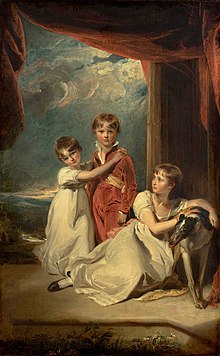
-
- Bosch, Hieronymus – i painting
- Cranach, Lucas (the Elder) – 1 painting
- Dornicke, Jan van – 1 painting
- Dyck, Anthony van – two paintings
- Hals, Frans – iii paintings
- Holbein, Hans (the Younger) – 1 painting
- Massys, Quentin – 1 painting, Ill-Matched Spousal relationship
- Memling, Hans – 1 painting
- Oolen, Jan van – 1 painting
- Post, Frans – 5 paintings
- Rembrandt – i painting, Portrait of a Young man with a Gilded Chain
- Rubens, Peter Paul(and workshop) – 1 painting
- Ruysdael, Salomon van – 1 painting
- Van Gogh, Vincent – 5 paintings
English language schoolhouse
-
- Constable, John – 1 painting
- Gainsborough, Thomas – 3 paintings
- Hogarth, William – 1 painting
- Lawrence, Thomas (and workshop) – 2 paintings
- Raeburn, Henry – 1 painting
- Reynolds, Joshua – one painting
- Romney, George – one painting
- Turner, J. M. Due west. – i painting
The museum also has some pocket-size collections of photographs, costumes and textiles, kitsch objects, etc.
Theft [edit]
On 20 Dec 2007, around 5:09 am, three men invaded the museum and took two paintings, considered to be amongst the about valuable of the museum: O Lavrador de Café (The Java Farmer), by Cândido Portinari, and the Portrait of Suzanne Bloch by Pablo Picasso. The whole action took near three minutes.[14] Art experts estimated value of the paintings at nigh 55 or 56 1000000 dollars.[15] The paintings were recovered by the Brazilian police on 8 January 2008, in the city of Ferraz de Vasconcelos, in the Greater São Paulo.[16]
Gallery [edit]
-

Pietro Perugino (Italian, 1447/49-1523) St. Sebastian spring to a column, c.1500/10.
-
-

Delacroix (French, 1798–1863) The autumn - Bacchus and Ariadne, 1856/63.
-
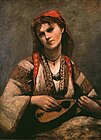
Corot (French, 1796–1875) Gypsy Girl with a mandolin, 1874.
-

Hans Memling (German, 1435–1494) The mourning Virgem with St. John the Baptist and the pious women of Galilee, 1485/ninety.
-

Hans Holbein (German language, 1497–1543) The poet Henry Howard, Count of Surrey, c. 1542.
-

Van Gogh (Dutch, 1853–1890) The Student, 1888.
-

Guido Reni (1575–1642). The Suicide of Lucretia, 1625–1640.
Come across also [edit]
- Museum of Contemporary Art, University of São Paulo
- Ema Gordon Klabin Cultural Foundation
- Eva Klabin Foundation
- MASP Antiquarian Market
- Museu Nacional de Belas Artes
- Pinacoteca practise Estado de São Paulo
References [edit]
- ^ "Relatõrio Anual de Atividas MASP 2015" (PDF) (in Portuguese). São Paulo Museum of Fine art. 2016. p. 44. Retrieved 29 September 2017.
- ^ "Museum of Art of São Paulo Assis Chateaubriand, São Paulo, Brazil, interactive Google street view photo and map". Geographic.org . Retrieved x August 2016.
- ^ Regime seek shut-down of renowned São Paulo art museum, CBCNews, 19 January 2008, retrieved 25 June 2009
- ^ a b São Paulo Museum of Art, Encyclopaedia Itaú Cultural Visual Arts, retrieved 25 June 2009
- ^ Preciosidades de um MASP sessentão (in Portuguese), Hipermeios, archived from the original on ten July 2009, retrieved 25 June 2009
- ^ O Masp pede socorro (in Portuguese), Forum Permanente, archived from the original on ten July 2009, retrieved 25 June 2009
- ^ IPHAN – Official annotation (in Portuguese), IPHAN, retrieved 25 June 2009
- ^ Bardi, P.M. (1992), História practise MASP, São Paulo: Instituto Quadrante, pp. x–14, ISBN85-7234-019-Ten
- ^ MASP – Um museu no país das idéias audazes (in Portuguese), Instituto Lina Bo east P.M. Bardi, retrieved 25 June 2009
- ^ Maciel, Carlos Alberto. Técnica moderna: entre o monumento e a construção cotidiana Archived 27 September 2007 at the Wayback Machine. Retrieved 26 June 2007.
- ^ CEDAC. São Paulo 450 anos. Retrieved 2007-half-dozen-26.
- ^ Oliveira, Fernanda. MASP: sob every bit linhas da arte, a liberdade Archived 12 October 2006 at the Wayback Machine. Retrieved 26 June 2007.
- ^ João Domingues (28 October 2004). "MASP pede socorro!" (in Portuguese). Canal Contemporâneo. Retrieved 26 June 2007.
- ^ "Picasso stolen from Brazil museum". BBC News. 20 December 2007. Retrieved 29 September 2017.
- ^ "Stolen Picasso Painting Found in Brazil". CBS News. 8 January 2008. Retrieved 29 September 2017.
- ^ Bruno Tavares; Rodrigo Pereira; Marcelo Godoy (8 January 2008). "Polícia recupera obras roubadas exercise Masp em dezembro – São Paulo – Estadão". Estadão (in Brazilian Portuguese). Retrieved 29 September 2017.
External links [edit]
 Media related to Museu de Arte de São Paulo at Wikimedia Eatables
- Official website
Source: https://en.wikipedia.org/wiki/S%C3%A3o_Paulo_Museum_of_Art#:~:text=It%20is%20well%20known%20for,symbol%20of%20modern%20Brazilian%20architecture.
0 Response to "The Museum of Art of Sao Paulo Construction Type"
Post a Comment